Posts

Ukraine: Unlawful Russian Attacks in Kharkiv

Ukraine: Unlawful Russian Attacks in Kharkiv

[ad_1]

(Kyiv, August 16, 2022) – Russian forces have assaulted Kharkiv, Ukraine’s second-largest city, with repeated unlawful attacks that killed and wounded civilians and damaged healthcare facilities and homes, Human Rights Watch said today. All of the attacks that Human Rights Watch documented were carried out in populated areas by indiscriminately using explosive weapons with wide area effects and widely banned cluster munitions in apparent violation of international humanitarian law, or the laws of war.

During recent visits to Kharkiv and the neighboring town of Derhachi, Human Rights Watch documented eight unlawful incidents of attacks that killed 12 civilians, wounded 26 others, and damaged at least 5 hospital buildings – just a fraction of attacks reported in the Kharkiv region since Russia’s full-scale invasion began on February 24, 2022. As well as Human Rights Watch could determine, Russian forces did not take the precautions required by the laws of war to minimize civilian harm in any of the documented attacks, three of them with cluster munitions.

“Russian forces have pummeled Kharkiv and surrounding areas, attacking densely populated residential neighborhoods with indiscriminate weapons,” said Belkis Wille, senior crisis and conflict researcher at Human Rights Watch. “In the cases we documented, Russian forces appeared to show little regard for civilian lives and the laws of war.”

According to the Kharkiv region’s deputy prosecutor, Andrii Kravchenko, at least 1,019 civilians, including 52 children, have been killed and 1,947 others wounded, including 152 children, during hundreds of attacks by Russian forces in the Kharkiv region since late February.

Between May 24 and June 28, Human Rights Watch researchers inspected the sites of eight of these cases, including three in Kharkiv and five in Derhachi, and interviewed 28 people, including 22 witnesses to the eight incidents, hospital workers, State Emergency Service representatives, and local prosecutors. Some people asked to withhold their surnames or their full names for security reasons.

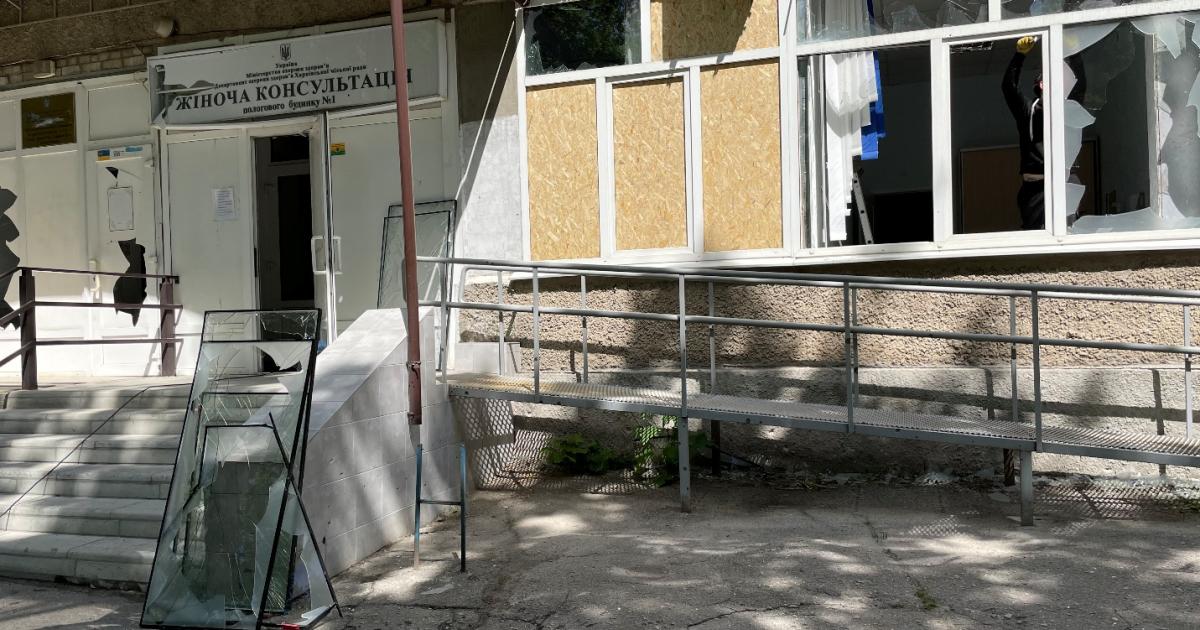
Two volunteers were wounded on May 12 when a cluster munition rocket pierced the roof of a cultural center in Derhachi, where workers were preparing food and other aid for local residents. At around the same time, submunitions – possibly from the same rocket – landed in the garden of a couple who lived about a kilometer away, killing both. On May 23, a cluster munition attack struck a maternity clinic building in Kharkiv city, wounding a man at a bus stop outside the clinic building and damaging the building’s façade, windows, and pharmacy.

On May 26 a 63-year-old man taking a walk was killed when a munition landed in Kharkiv’s August 23 Square park. About a kilometer away, a woman who had just started a new job at a salon said her husband, who had come to take her home, and their 4-month-old baby boy were killed when a munition struck near the salon. The woman and a colleague were injured, and a client was also killed.  

Ukraine deploys military forces inside the city of Kharkiv, but in seven of the incidents of attacks, Human Rights Watch found no evident military objective – such as armed forces, weapons, or bases or other positions – in the vicinity of the attack. In one attack that damaged a hospital, there may have been a small Ukrainian military presence nearby, but the special protections provided to medical facilities under the laws of war meant this attack was still unlawful.

All of the incidents of attacks documented were in apparent violation of the laws of war. Russian forces appear to have used munitions indiscriminately, including in three attacks with cluster munitions and three others with explosive weapons in populated areas. Three attacks damaged hospitals, including two with cluster munitions. The attacks were unlawfully indiscriminate because they were not directed at a specific military target or could not distinguish between civilians or civilian objects and military objectives.

Since February 2022, Russian forces have repeatedly used cluster munitions, which are inherently indiscriminate, in attacks across the country that have killed hundreds of civilians and damaged homes, hospitals, and schools. Ukrainian forces have used cluster munitions on at least two known occasions since the full-scale invasion began. These weapons are banned under the 2008 Convention on Cluster Munitions because of their widespread indiscriminate effect and long-lasting danger to civilians. Cluster munitions typically open in the air and send dozens, even hundreds, of small bomblets over an area the size of a football field. Many of these submunitions fail to explode on initial impact, leaving duds that act like landmines.

A State Emergency Service representative in Kharkiv said that between February 24 and May 7, the service had collected 2,700 unexploded submunitions in the city and surrounding…

[ad_2]

Source link
Latest news on Russia and the war in Ukraine

Latest news on Russia and the war in Ukraine

[ad_1]

Biden warns Xi of global backlash

Joe Biden speaks with Xi Jinping, March 18, 2022.

The White House

Biden held a nearly two-hour phone call with Chinese President Xi Jinping to discuss Russia’s invasion of Ukraine.

Both Biden and Xi agreed on the need to promote peace and assist with the humanitarian disaster created by the invasion. But they disagreed deeply on who is responsible for the suffering in Ukraine, with the Chinese leader refusing to hold Russia singularly accountable for the unprovoked invasion.

Instead, official readouts from Beijing made it clear that Xi’s position was that the U.S. and Europe had provoked Russian President Vladimir Putin into attacking Ukraine by expanding NATO into Eastern Europe.

During the call, Biden “described the implications and consequences if China provides material support to Russia,” the White House said.

— Christina Wilkie

Canada welcomes Ukrainian refugees

Canada’s Prime Minister Justin Trudeau visits Church of St Demetrius the Great Martyr to speak with members of the Ukrainian community as Russia’s invasion of Ukraine continues, in Toronto, Ontario, Canada, March 4, 2022.

Carlos Osorio | Reuters

Canadian Prime Minister Justin Trudeau said the country has opened a temporary residency program for Ukrainian refugees.

Canada is now taking applications that will allow Ukranians to stay as temporary residents for up to three years under an extended visitor visa program, as opposed to a six-month visa.

The program expedites processing and waives application fees.

— Dawn Kopecki

U.S. targets Abramovich plane, 99 others over Russia export violations

A plane, according to Swiss media reports believed to be used in the past by Russian billionaire Roman Abramovich, is pictured on the grounds of EuroAirport Basel Mulhouse Freiburg near Mulhouse, France, March 9, 2022.

Arnd Wiegmann | Reuters

The U.S. Commerce Department will effectively ground 100 airplanes that have recently flown to Russia and are believed to violate U.S. export controls, including a plane used by Russian businessman Roman Abramovich, officials told Reuters.

The list, seen by Reuters, includes 99 Boeing airplanes operated by Russian passenger and cargo carriers including Aeroflot, AirBridge Cargo, Utair, Nordwind, Azur Air and Aviastar-TU — as well as Abramovich’s Gulfstream G650 — and could further hinder Russian efforts to continue some international flights.

The Commerce Department will warn companies and other entities around the world that any refueling, maintenance, repair, or spare parts or services violate U.S. export controls and subject companies to U.S. enforcement actions that could include “substantial jail time, fines, loss of export privileges, or other restrictions,” the department said.

— Reuters

Russia celebrates 8th anniversary of the annexation of Crimea

Russians celebrate the 8th anniversary of the annexation of Crimea.

People hold a banner reading “For Putin!” during a concert marking the eighth anniversary of Russia’s annexation of Crimea at Luzhniki Stadium in Moscow, Russia March 18, 2022. 

Pavel Bednyakov | Reuters

A woman poses for pictures from behind a car door with its window decorated with the letter “Z”, which has become a symbol of support for Russian military action in Ukraine, during celebrations marking the eight anniversary of Russia’s annexation of Crimea in Simferopol on March 18, 2022.

Stringer | AFP | Getty Images

People wave Russian flags during a concert marking the eighth anniversary of Russia’s annexation of Crimea at Luzhniki Stadium in Moscow, Russia March 18, 2022. 

Ramil Sitdikov | Reuters

A man holds a portrait of Russian President Vladimir Putin during celebrations of the eighth anniversary of Russia’s annexation of Crimea in Simferopol, Crimea March 18, 2022.

Alexey Pavlishak | Reuters

Russian President Vladimir Putin delivers a speech during a concert marking the eighth anniversary of Russia’s annexation of Crimea at Luzhniki Stadium in Moscow, Russia March 18, 2022.

Alexander Vilf | Reuters

Zaporizhzhya nuclear power plant expected to be working again next week

French public nuclear safety institute IRSN said on December 3, 2014 it had not detected any unusual radioactivity in Ukraine and that the incident at a nuclear power plant in Zaporizhzhya posed no danger for populations or the environment.

Reuters

Ukrainian officials expect that the Zaporizhzhya nuclear power plant will be working again next week after the site was damaged by Russian shelling.

Ukrainian engineers are currently repairing one of three disconnected power lines linking the country’s largest nuclear power plant to the electricity grid, International Atomic Energy Agency Director General Rafael Mariano Grossi wrote in a statement.

Russian forces took control of the Zaporizhzhya nuclear power plant on March 4. A week prior, Russian forces took control of the Chornobyl nuclear power plant.

– Amanda Macias

State Department denied access to Brittney Griner in Russia

A close up shot of Brittney Griner #42…

[ad_2]

Source link

Latest Russia-Ukraine news: Ukraine Air Force shoots down several Russian aircrafts with missiles - New York Post

Latest Russia-Ukraine news: Ukraine Air Force shoots down several Russian aircrafts with missiles – New York Post

[ad_1]

Latest Russia-Ukraine news: Ukraine Air Force shoots down several Russian aircrafts with missiles  New York Post

[ad_2]

Source link

Ukraine: As fears mount over potential Russian invasion US considering sending extra weaponry

Ukraine: As fears mount over potential Russian invasion US considering sending extra weaponry

[ad_1]

The discussions about the proposed lethal aid package are happening as Ukraine has begun to warn publicly that an invasion could happen as soon as January. The package could include new Javelin anti-tank and anti-armor missiles as well as mortars, the sources said.

Air defense systems, such as stinger missiles, are also under consideration, and the Defense Department has been pressing for some equipment that would have gone to Afghanistan — like Mi-17 helicopters — to instead be sent to Ukraine. The Mi-17 is a Russian helicopter that the US originally purchased to give to the Afghans. The Pentagon is now weighing what to do with them after the US withdrawal from Afghanistan in August.

But others in the administration are concerned that sending stingers and helicopters could be seen by Russia as a major escalation. And while they are prepared to send some military advisers into the region, it is unclear whether any would go into Ukraine itself, the people said.

Retired Lt. Col. Cedric Leighton told CNN that Javelin antitank missiles “are quite effective against the T-80 tanks which the Russians are actually employing in these efforts against Ukraine right now.” But he noted that any additional assistance to Ukraine undoubtedly risks “further heightening tensions” with Moscow.

Sanctions discussions

Meanwhile, US officials have been holding discussions with European allies about putting together a new sanctions package that would go into effect if Russia invaded Ukraine, the sources said. And lawmakers are also jockeying over new sanctions language to include in the National Defense Authorization Act.

Asked about the Russian military activity, White House Press Secretary Jen Psaki told reporters on Monday that the administration is concerned and has “had extensive interactions with our European allies and partners in recent weeks, including with Ukraine.” She added that the US has “also had held discussions with Russian officials about Ukraine and US-Russian relations in general.” The Chairman of the Joint Chiefs of Staff, Gen. Mark Milley, also spoke by phone with the Commander-in-Chief of the Ukrainian Armed Forces Lt. Gen. Valery Zaluzhny on Monday.

The discussions reflect how seriously the Biden administration and Congress is taking the possibility that Russia could move to invade Ukraine, a strategic US ally, for the second time in under a decade. And US officials are determined not to be caught by surprise by a Russian military operation, as the Obama administration was in 2014 when Russia invaded Crimea and powered an insurgency in parts of eastern Ukraine.

“Our concern is that Russia may make a serious mistake of attempting to rehash what it undertook back in 2014, when it amassed forces along the border, crossed into sovereign Ukrainian territory and did so claiming falsely that it was provoked,” Secretary of State Antony Blinken said last week.

US struggles with intelligence blind spot as Russia builds up forces near Ukraine

Russia’s foreign intelligence service, the SVR, pushed back on the US’ warnings about a potential invasion, calling them “absolutely false” in a statement on Monday.

“The US State Department through diplomatic channels brings to its allies and partners absolutely false information about the concentration of forces on the territory of our country for a military invasion of Ukraine,” said Sergei Ivanov, head of the SVR’s press bureau.

For weeks, the US has been sharing intelligence with NATO partners and European allies on unusual Russian troop movements near the Ukrainian border that US military and intelligence officials believe could be a precursor to a military operation on the country’s eastern flank. The briefings have gone much further than in the past in terms of the level of alarm and specificity, US, European, and Ukrainian sources familiar with the discussions said.

Ukraine’s tone has also changed significantly since being briefed by the US. At the beginning of the month, Ukrainian officials downplayed reports that Russia was massing forces near the border. Now, following extensive meetings between US and Ukrainian officials, Ukraine’s defense intelligence chief Brig. Gen. Kyrylo Budanov is publicly warning that Russia is building a capacity to attack as soon as January — a timeline in line with the US’ assessments.

‘No smoking gun’

Still, officials say Russia’s ultimate plan remains unclear. “There is no smoking gun or decisive indicator of Putin’s intentions,” said one defense official. And it is possible that the maneuvers are an effort to sow confusion or to coerce the west into making concessions, rather than a precursor to an invasion.

But the US is still warning of the possibility of the worst-case scenario that Moscow attempts regime change in Kiev, spurred largely by Putin’s determination to keep Ukraine from growing closer to the West and potentially joining NATO.

Blinken says US is concerned Russia may be 'attempting to rehash' 2014 invasion of Ukraine

“You don’t achieve that goal by carving out another chunk of the eastern Donetsk region,” said one person familiar with the intelligence. “It’s got to be something…

[ad_2]

Source link