
Ukraine: Unlawful Russian Attacks in Kharkiv
[ad_1]
(Kyiv, August 16, 2022) – Russian forces have assaulted Kharkiv, Ukraine’s second-largest city, with repeated unlawful attacks that killed and wounded civilians and damaged healthcare facilities and homes, Human Rights Watch said today. All of the attacks that Human Rights Watch documented were carried out in populated areas by indiscriminately using explosive weapons with wide area effects and widely banned cluster munitions in apparent violation of international humanitarian law, or the laws of war.
During recent visits to Kharkiv and the neighboring town of Derhachi, Human Rights Watch documented eight unlawful incidents of attacks that killed 12 civilians, wounded 26 others, and damaged at least 5 hospital buildings – just a fraction of attacks reported in the Kharkiv region since Russia’s full-scale invasion began on February 24, 2022. As well as Human Rights Watch could determine, Russian forces did not take the precautions required by the laws of war to minimize civilian harm in any of the documented attacks, three of them with cluster munitions.
“Russian forces have pummeled Kharkiv and surrounding areas, attacking densely populated residential neighborhoods with indiscriminate weapons,” said Belkis Wille, senior crisis and conflict researcher at Human Rights Watch. “In the cases we documented, Russian forces appeared to show little regard for civilian lives and the laws of war.”
According to the Kharkiv region’s deputy prosecutor, Andrii Kravchenko, at least 1,019 civilians, including 52 children, have been killed and 1,947 others wounded, including 152 children, during hundreds of attacks by Russian forces in the Kharkiv region since late February.
Between May 24 and June 28, Human Rights Watch researchers inspected the sites of eight of these cases, including three in Kharkiv and five in Derhachi, and interviewed 28 people, including 22 witnesses to the eight incidents, hospital workers, State Emergency Service representatives, and local prosecutors. Some people asked to withhold their surnames or their full names for security reasons.
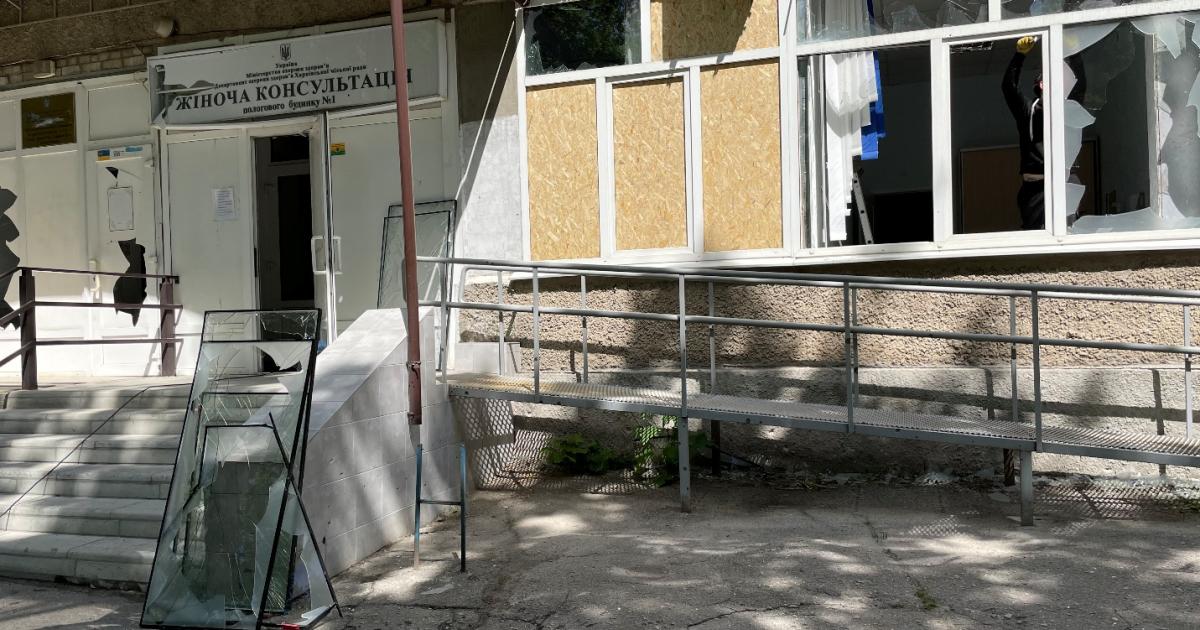
Two volunteers were wounded on May 12 when a cluster munition rocket pierced the roof of a cultural center in Derhachi, where workers were preparing food and other aid for local residents. At around the same time, submunitions – possibly from the same rocket – landed in the garden of a couple who lived about a kilometer away, killing both. On May 23, a cluster munition attack struck a maternity clinic building in Kharkiv city, wounding a man at a bus stop outside the clinic building and damaging the building’s façade, windows, and pharmacy.
On May 26 a 63-year-old man taking a walk was killed when a munition landed in Kharkiv’s August 23 Square park. About a kilometer away, a woman who had just started a new job at a salon said her husband, who had come to take her home, and their 4-month-old baby boy were killed when a munition struck near the salon. The woman and a colleague were injured, and a client was also killed.
Ukraine deploys military forces inside the city of Kharkiv, but in seven of the incidents of attacks, Human Rights Watch found no evident military objective – such as armed forces, weapons, or bases or other positions – in the vicinity of the attack. In one attack that damaged a hospital, there may have been a small Ukrainian military presence nearby, but the special protections provided to medical facilities under the laws of war meant this attack was still unlawful.
All of the incidents of attacks documented were in apparent violation of the laws of war. Russian forces appear to have used munitions indiscriminately, including in three attacks with cluster munitions and three others with explosive weapons in populated areas. Three attacks damaged hospitals, including two with cluster munitions. The attacks were unlawfully indiscriminate because they were not directed at a specific military target or could not distinguish between civilians or civilian objects and military objectives.
Since February 2022, Russian forces have repeatedly used cluster munitions, which are inherently indiscriminate, in attacks across the country that have killed hundreds of civilians and damaged homes, hospitals, and schools. Ukrainian forces have used cluster munitions on at least two known occasions since the full-scale invasion began. These weapons are banned under the 2008 Convention on Cluster Munitions because of their widespread indiscriminate effect and long-lasting danger to civilians. Cluster munitions typically open in the air and send dozens, even hundreds, of small bomblets over an area the size of a football field. Many of these submunitions fail to explode on initial impact, leaving duds that act like landmines.
A State Emergency Service representative in Kharkiv said that between February 24 and May 7, the service had collected 2,700 unexploded submunitions in the city and surrounding…
[ad_2]
Source link
 Men stand outside a storage facility of oil giant ADNOC in…