
Posts

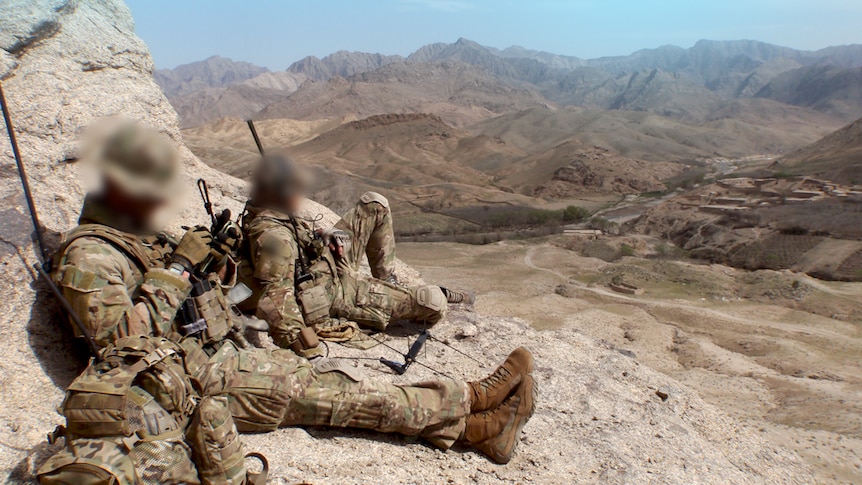
3 Squadron SAS soldiers rest on a mountain in Afghanistan in 2012.

Afghanistan’s rapid collapse fuels anger within elite SAS over public ‘mistreatment’

[ad_1]

The Taliban’s swift re-emergence is reigniting bitterness inside Australia’s most elite military unit over the way SAS soldiers were dealt with following damning Afghanistan war crime allegations.

Despite recent praise for its role in the Afghanistan evacuation mission, sources inside the highly secretive Special Air Service Regiment (SASR) say morale is at “rock bottom,” and the rival 2nd Commando Regiment “appears to be taking over” special forces command.

Last year the Brereton inquiry found “credible evidence” that Australian special forces were responsible for the murder of at least 39 Afghans during this country’s longest war. 

This week the government unveiled a “command and control” overhaul of the SAS, saying it would make the regiment “stronger and ready for the challenges ahead”. 

A recent open letter written by a former “senior” non-commissioned SAS officer claims many Afghanistan veterans are being removed from the regiment after being “judged guilty by association”.

The anonymous soldier, who claims he too was “recently forced out” despite no “adverse findings” from his Afghanistan service, argues many colleagues are also having “their careers stripped away from them”.

“Multiple SASR operators who served in Afghanistan and who didn’t receive a Potentially Affected Persons notice (PAP) are systematically being forced out of the SASR,” the officer writes.

SAS soldiers with two dogs overlook a valley in Afghanistan in 2012.
More than 100 people attached to the SAS have reportedly left the regiment since the release of a war crimes inquiry.(

Supplied

)

In the document, titled The Piecemeal Destruction of Australia’s Special Missions Unit, the author claims “right now there are currently 50 middle management SASR operators discharging from SASR and ADF”.

Another SAS figure, speaking to the ABC on the condition of anonymity, claimed a total of “more than 100” members of the elite unit had left since November’s public release of the Brereton report.

“The Commandos are slowly taking over the Special Operations Command (SOCOMD) which is now also run by an officer that has never served with the SAS.”

The Defence Department has declined to say how many members of the SASR have left following the Brereton inquiry.

But it recently confirmed it has commenced “administrative action” against 17 soldiers who served in Afghanistan.

“Army initiated administrative action, inclusive of a Notice to Show Cause, for termination of service against 17 individuals where alleged failure to comply with Australian Defence Force expectations and values was identified,” the Department said on its website.

The ABC understands 13 of the soldiers have since been discharged for medical or other reasons, while three remain in full time or reserve service, and another is now serving with the United Arab Emirates military.

Last week Defence Minister Peter Dutton publicly apologised to soldiers who had their “show cause” notices withdrawn because of a lack of evidence to warrant further investigation.

“Clearly if people have been wrongly accused and they have now been cleared of that then I do apologise for what they have been through, what their families have been through,” Mr Dutton told Radio 2GB.

Defence has also declined to comment on speculation former SAS members may take legal action against the army for the manner in which they were removed.

[ad_2]

Source link

Taliban Sweep Across Afghanistan's South, Taking At Least Three More Cities : NPR

Taliban Sweep Across Afghanistan’s South, Taking At Least Three More Cities : NPR

[ad_1]

Taliban fighters patrol inside the city of Ghazni, southwest of Kabul, Afghanistan, on Thursday. The Taliban captured the provincial capital near Kabul on Thursday, the 10th the insurgents have taken over a weeklong blitz across Afghanistan as the U.S. and NATO prepare to withdraw entirely from the country after decades of war.

Gulabuddin Amiri/AP


hide caption

toggle caption

Gulabuddin Amiri/AP


Taliban fighters patrol inside the city of Ghazni, southwest of Kabul, Afghanistan, on Thursday. The Taliban captured the provincial capital near Kabul on Thursday, the 10th the insurgents have taken over a weeklong blitz across Afghanistan as the U.S. and NATO prepare to withdraw entirely from the country after decades of war.

Gulabuddin Amiri/AP

KABUL, Afghanistan — The Taliban captured another three provincial capitals in southern Afghanistan on Friday, including in Helmand, the scene of some of the heaviest fighting in the past two decades, as the insurgents press a lightning offensive that is gradually encircling the capital, Kabul.

The loss of Helmand’s provincial capital comes after years of toil and blood spilled by American, British and allied NATO forces. Hundreds of foreign troops were killed there over the course of the nearly two-decade war.

The insurgents have taken more than a dozen provincial capitals in recent days and now control more than two-thirds of the country just weeks before the U.S. plans to withdraw its last troops.

Attaullah Afghan, the head of the provincial council in Helmand, says that Taliban captured the provincial capital of Lashkar Gah following heavy fighting and raised their white flag over governmental installations. He says that three national army bases outside of Lashkar Gah remain under control of the government.

Atta Jan Haqbayan, the provincial council chief in Zabul province, said the local capital of Qalat fell to the Taliban and that officials are in a nearby army camp preparing to leave.

Two lawmakers from Afghanistan’s southern Uruzgan province said local officials have surrendered the provincial capital, Tirin Kot, to the rapidly advancing Taliban. Bismillah Jan Mohammad and Qudratullah Rahimi confirmed the surrender Friday. Mohammad says the governor is en route to the airport to depart for Kabul.

The latest advances came hours after the insurgents captured the country’s second and third largest cities in a lightning advance. The seizures of Kandahar and Herat mark the biggest prizes yet for the Taliban.

While Kabul isn’t directly under threat yet, the losses and the battles elsewhere further tighten the grip of a resurgent Taliban, who are estimated to now hold over two-thirds of the country and continue to press their offensive.

With security rapidly deteriorating, the United States planned to send in 3,000 troops to help evacuate some personnel from the U.S. Embassy in Kabul. Separately, Britain said about 600 troops would be deployed on a short-term basis to support British nationals leaving the country, and Canada is sending special forces to help evacuate its embassy.

Thousands of Afghans have fled their homes amid fears the Taliban will again impose a brutal, repressive government, all but eliminating women’s rights and conducting public executions.

Peace talks in Qatar remain stalled, though diplomats are still meeting, as the U.S., European and Asian nations warned that any government established by force would be rejected.

“We demand an immediate end to attacks against cities, urge a political settlement, and warn that a government imposed by force will be a pariah state,” said Zalmay Khalilzad, the U.S. envoy to the talks.

Fazel Haq Ehsan, chief of the provincial council in the western Ghor province, said Friday that the Taliban had entered Feroz Koh, the provincial capital, and that there was fighting inside the city. The Taliban meanwhile claimed to have captured Qala-e Naw, capital of the western Badghis province. There was no official confirmation.

The Taliban are also on the move in Logar province, just south of Kabul, where they claim to have seized the police headquarters in the provincial capital of Puli-e Alim as well as a nearby prison. The city is some 80 kilometers (50 miles) south of Kabul.

The latest U.S. military intelligence assessment suggests Kabul could come under insurgent pressure within 30 days and…

[ad_2]

Source link