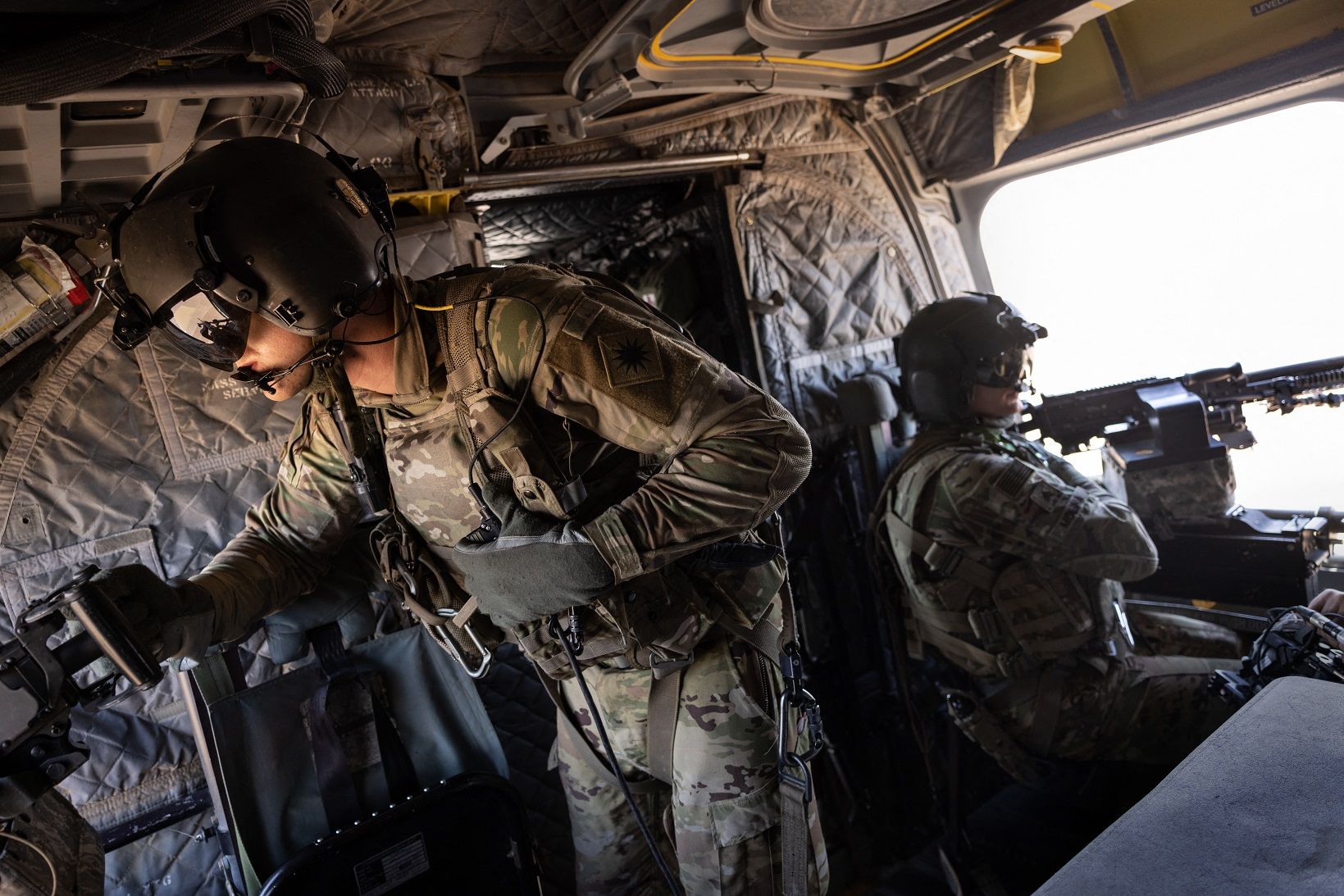
US Army CH-47 Chinook helicopter gunners scan the desert while transporting troops on May 26, 2021 over northeastern Syria.

US-led Forces Raid Jihadists In Northwestern Syria

[ad_1]

‘Confirmed reports of fatalities’ in the largest raid by coalition forces since 2019

Troops from the US-led anti-jihadist coalition landed in northwest Syria Thursday in search of wanted militants, resulting in clashes, the Syrian Observatory for Human Rights reported.

The Observatory, which relies on a network of sources inside Syria, said the helicopter-borne forces touched down near camps for displaced people in Atme, a town close to the border with Turkey in jihadist-dominated Idlib province.

Observatory chief Rami Abdel Rahman told AFP the operation was the largest since coalition special forces launched an October 2019 raid in Idlib that led to the killing of Islamic State (IS) chief Abu Bakr al-Baghdadi.

The clashes lasted for two hours in the area, the monitor said, and the identities of the jihadists who were the focus of the operation have not been released.

The Observatory said there were “confirmed reports of fatalities” without providing details about their number or identities.

Residents in the area told AFP they heard shelling and gunfire.

In an audio recording circulating among residents and attributed to the coalition, an Arabic speaker can be heard asking women and children to evacuate their homes in the targeted area.

The international coalition, created to fight IS, did not reply to an AFP request for comment about the operation.

There are crowded camps in the Atme area that experts say jihadist leaders are using as bases to hide among people displaced by the conflict.

The coalition often conducts strikes in Idlib targeting jihadist leaders linked to Al-Qaeda. 

On October 23, the US military announced the killing of Al-Qaeda senior leader Abdul Hamid Al-Matar.

“Al-Qaeda uses Syria as a safe haven to rebuild, coordinate with external affiliates, and plan external operations,” said Central Command spokesman Army Major John Rigsbee in a statement at that time.

Idlib is dominated by the jihadist group Hayat Tahrir al-Sham (HTS), which includes leaders of Al-Qaeda’s former Syria chapter.

[ad_2]

Source link

NATO back in its comfort zone after the chaos of Afghanistan

NATO back in its comfort zone after the chaos of Afghanistan

[ad_1]

NATO Secretary General Jens Stoltenberg, center, participates in a media conference with Finland’s Foreign Minister Pekka Haavisto, left, and Sweden’s Foreign Minister Ann Linde, right, at NATO headquarters in Brussels, Monday, Jan. 24, 2022.

NATO Secretary General Jens Stoltenberg, center, participates in a media conference with Finland’s Foreign Minister Pekka Haavisto, left, and Sweden’s Foreign Minister Ann Linde, right, at NATO headquarters in Brussels, Monday, Jan. 24, 2022. (Olivier Matthys/AP)

BRUSSELS — NATO is right back in its element. As tensions mount with Russia, the world’s biggest military organization is focused on security: defending the territory of its 30 member countries. That involves deterring any attempt to destabilize countries on its eastern flank like Estonia, Latvia, Lithuania and Poland.

Members of the U.S.-led alliance have diverse interests in their dealings with Russia, and in their dealings with the current focus of President Vladimir Putin’s ire — Ukraine. But NATO is not riven by business, political and energy concerns in the same way the European Union is. It does not do sanctions.

Founded in 1949, the North Atlantic Treaty Organization was laser-focused on the Soviet Union during the Cold War, and dealing with Moscow is in its DNA. Indeed, the dispute with Russia over Ukraine is almost a relief after the debacle in Afghanistan, which the Taliban overran after NATO left last year.

NATO takes its decisions unanimously and every country has a veto. So NATO as an organization will not supply arms to Ukraine, even though many of its members are doing to, including the United States, Britain, Turkey and the Baltic countries.

Germany is the biggest member country that isn’t sending offensive weapons, but it’s not alone, and Berlin is nevertheless providing non-lethal equipment.

NATO also will not send troops into Ukraine if Russia invades.

Article 5 of its founding treaty — the key mutual defense clause — obliges all member countries to come to the aid of another member whose sovereignty or territorial integrity might be under threat.

Ukraine, however, is not a member, much as it would like to be. It has contributed to NATO operations and missions in Bosnia-Herzegovina, Kosovo, Iraq, Afghanistan and elsewhere, but this is not enough to warrant the protection of NATO’s shield.

A Belgium Air Force F-16 fighter jet participate in NATO’s Baltic Air Policing Mission operate in Lithuanian airspace, on, Jan. 25, 2022.

A Belgium Air Force F-16 fighter jet participate in NATO’s Baltic Air Policing Mission operate in Lithuanian airspace, on, Jan. 25, 2022. (Lithuanian Ministry of National Defense via AP)

Irrespective of Putin’s insistence that Ukraine must never become a NATO member, the alliance’s members also would not admit it in at the moment, not while Russia holds the Crimean Peninsula and fighting continues in the eastern Donbas region. Article 5 obligations could start a war if it did, as Ukraine would probably insist on joining with its territory intact, Crimea and the Donbas included.

In the meantime, NATO is helping Kyiv to thoroughly reform its security and defense sector.

What NATO will do should Putin cross its red line is reinforce its own members’ defenses in the Baltic countries, Poland, and in the Black Sea area, near Bulgaria and Romania. As for what that red line is, that’s unclear — it might be as little as a cyberattack or an artillery strike on Ukraine, or it might require an all-out invasion.

NATO began beefing up its defenses in northeastern Europe after Russia annexed Crimea in 2014. It now has around 5,000 troops and equipment stationed there. But it also plans to send troops, aircraft and warships to the Black Sea region. France, the Netherlands and Spain are among those taking part.

The Pentagon has put up to 8,500 U.S. troops on heightened alert, so they will be prepared to deploy if needed to reassure other allies in the event of an attack. Those troops would be attached to the NATO Response Force, a 20,000-strong force with land, air, sea and special forces components.

A quickly deployable land brigade of around 5,000 troops, currently run by France, has already been beefed up. Germany, Poland, Portugal and Spain are also contributing to this outfit, known as the Very High Readiness Joint Task Force.

In an effort to ward off an attack, NATO has extended the offer of wide-ranging talks to Moscow. It wants to improve communications, examine ways to avoid military incidents, set up a civilian hotline for emergencies and discuss missile deployments. But it refuses to halt the admission of new members.

Certainly, NATO has had its share of disputes recently. Among them are former U.S. President Donald Trump’s threat not to defend allies with insufficient defense budgets; Turkey’s purchase of Russian-made missile defense systems; French President Emmanuel Macron’s claim that NATO was suffering “brain-death”; and the chaotic U.S.-run exodus from Afghanistan after 18 years which handed victory to the Taliban.

But NATO has mostly weathered…

[ad_2]

Source link

Klein High School becomes home to first U.S. Space Force JROTC in Texas

Texas’ first Space Force JROTC initiated in Klein High School

[ad_1]

“Today, our unit is officially converted to the first Space Force Junior ROTC unit in Texas history,” said student Alissa Zenero.

Zenero is the unit’s Lieutenant Colonel.

It went from an Air Force JROTC unit to a Space Force JROTC unit.

“Sir, I assume command,” Zenero said during a special ceremony on Tuesday.

Last year, the Air Force selected just 10 JROTC units from across the nation to transition into the first Space Force JROTCs.

“It’s a great reminder to us that our business is always about the future and the next generation and the wonderful things that they’re going to do,” said Lt. Gen. John E. Shaw, presiding officer of the U.S. Space Force and deputy commander of the U.S. Space Command.  “In addition to all the other things that we do, we now need a military branch that’s going to protect and defend our capabilities in space.”

Klein cadets may end up having lengthy career in the nation’s newest Armed Forces branch.

“Thank you for representing the absolute best in Klein ISD,” said superintendent Jenny McGown.

[ad_2]

Source link

A photo of a young woman wearing blue eyeliner, smiling at the camera.

The US military has a problem with domestic violence. A culture of sexism and secrecy makes it harder to solve

[ad_1]

In the early evening of December 20, 2020, neighbours watched helplessly as Keith Lewis threatened his wife Sarah Lewis in a driveway near their home in Fayetteville, North Carolina.

WARNING: This story contains graphic content that some readers may find upsetting.

In one arm, Keith carried the couple’s three-year-old daughter, Callie.

In the other, he held an assault rifle.

Sarah called 911 for help.

“He was cursing and screaming … and holding the little girl,” one of the neighbours told a 911 operator in a separate call.

The neighbour then described seeing Keith shoot his wife as she tried to hide behind a car.

When police arrived, Keith, a 31-year-old combat medic stationed at the nearby Fort Bragg army base, disappeared inside the couple’s weatherboard duplex.

After a 15-minute stand-off, he relinquished the toddler and took his own life. Sarah later died in hospital from multiple gunshot wounds, along with the couple’s unborn daughter, Isabella.

“[Sarah] was vivacious,” said Tammy De Mirza, her aunt, who hadn’t seen the couple since they moved to Fayetteville a few years previously.

“She was only 34. She had a lot of living to do.”

Ms De Mirza had planned to visit over the holidays: the new baby was due on Christmas Day.

The Lewises told family they were excited about the pregnancy, but their five-year marriage had long ago stopped being safe for Sarah, who served in the US Air Force before having two children in a previous marriage.

In October 2016, Keith was arrested for threatening her with a handgun, according to police.

A woman wearing glasses smiles at the camera.
The 34-year-old mother was described as “vivacious” by family.(Supplied: Lynda Lewis)

After returning to the United States from Afghanistan, he had continually struggled with his mental health and substance abuse but had kept working, rising through the ranks to the 1st Special Forces Command.

Nine days before her death, Sarah had contacted the unit for help, despite previously being met with scepticism and accused of “trying to ruin her husband’s career”, her aunt said.

The 1st Special Forces Command has no formal record of the call but a spokesperson for the unit said he hoped to clarify the course of events when Fayetteville Police release Sarah’s phone.

“Upon learning of the allegations, we immediately looked into the matter,” said Major Dan Lessard, the unit’s director of public affairs.

“Should any details come to light that demonstrate a leader was unresponsive … we will absolutely take appropriate action.”

“It doesn’t make any sense,” Ms De Mirza said.

“Why would you promote a guy that almost killed his wife?”

‘Command climate is critical’

There are factors endemic to life in the military that can increase the risk of domestic abuse, such as social isolation, mental health and substance-abuse issues, and the normalisation of violence within the ranks.

“The culture of the military is very hierarchical and it’s very masculine,” said Jessica Strong, the co-director of applied research at Blue Star Families, the country’s largest military support organisation.

There is currently no federal program to track the rate of intimate-partner violence in military families compared to the civilian population, but any comparison would likely be muddied by a reluctance to report abuse among military spouses, according to Ms Strong.

In 2017, a large-scale, biennial survey of military families by Blue Star Families found that among active-duty spouses who experienced physical abuse that year, the overwhelming majority — some 87 per cent — chose not to report it.

The top two reasons given were that they felt “it was not a big deal” or they “did not want to hurt their spouse or partner’s career”.

“They’re vulnerable and they’re dependent on their service member financially,” Ms Strong said.

“So, if they impact their service member’s career, they’re really hurting themselves.”

The famous five-sided headquarters of the US Department of Defense
The national Family Advocacy Program will receive $US216.8 million in 2022.(AP: Charles Dharapak)

According to the Pentagon, more than 40,000 incidents of domestic abuse involving service members were reported between 2015 and 2019, nearly three-quarters of which included physical violence — an offence under the Uniform Code of Military Justice (UCMJ), the legal code that governs US military services.

Eleven intimate partner violence fatalities were recorded in 2020.

Yet the Department of Defence’s (DOD) reporting on the problem is inconsistent, according to a recent investigation by the Government Accountability Office (GAO), which found a patchwork of data, despite a 1999 statutory requirement for all services to keep comprehensive records of alleged abuse.

“It appeared at that time that DOD was putting a framework in place to have the data necessary for oversight, along with taking care of the victims and making sure their needs were being…

[ad_2]

Source link

Here's what happening at Ukraine's border with Russia

Here’s what happening at Ukraine’s border with Russia

[ad_1]

For months, Russian troops have been increasingly positioning themselves at the Ukrainian border, traveling there from as far away as Siberia, sparking concerns of a planned incursion.

Now, Russia’s potential invasion of Ukraine has embroiled the Biden administration and its European allies in an acute diplomatic crisis.

With roughly 100,000 Russian soldiers, as well as tanks, artillery, helicopters and other equipment amassed to Ukraine’s north, east and south, many U.S. policymakers believe it is not a question of whether Russia will launch a new invasion of Ukraine, but how extensive that military campaign will be.

A satellite image of battle group deployments.

A satellite image of battle group deployments in Voronezh, Russia, on Jan. 16. (Maxar Technologies via AP)

This latest crisis follows years of aggression from Moscow toward Kyiv. In early 2014, Russian special forces stealthily invaded Ukraine’s strategically positioned Crimean Peninsula. Russia, ignoring international outcry, annexed Crimea soon after. That same year, Russian-backed separatists seized control of two eastern Ukrainian provinces, sparking a war there that has simmered ever since. An estimated 13,000 people have been killed in the conflict.

Breakneck talks between the U.S. and its European allies and Russia over the last two weeks have failed to resolve the crisis. Russia has demanded that NATO forbid Ukraine from ever joining the Western alliance, and also that it limit the deployment of NATO troops or weapons in countries on Russia’s border.

The U.S. and other NATO countries have rejected these proposals, citing the right of any qualifying country to join the alliance. Some Western officials view the Russian demands as so outlandish as to potentially be designed to scuttle talks.

On Wednesday, President Biden said he believed that Russian President Vladimir Putin “will move in” on Ukraine but warned of “severe costs and significant harm on Russia and the Russian economy” should Moscow invade.

President Biden gestures while standing at a podium.

President Biden at a news conference at the White House on Wednesday. (Chip Somodevilla/Getty Images)

Russia has lobbied counterthreats, saying it views certain kinds of sanctions — like cutting the country off from the international financial payments system — as tantamount to breaking off diplomatic relations, and has also threatened to move troops or military equipment to Cuba or Venezuela.

Russia’s endgame is opaque. Some analysts believe that Putin has backed himself into a corner and would now face negative domestic political consequences if he does not conduct some type of military offensive after months of saber-rattling.

Last week, the U.S. said it had intelligence showing that Russian troops were preparing a “false flag” operation in eastern Ukraine designed to make it appear that Ukrainian forces were attacking Russian troops — and that any Russian response would therefore be defensive in nature. U.S. officials believe the “false flag” could serve as the pretext for an invasion.

In what many experts believe is a preview of Russian actions during a larger military campaign, last week 70 Ukrainian government websites were also subject to a cyberattack.

A serviceman in a trench.

A serviceman takes his position in a trench near Yasne village in eastern Ukraine on Jan. 14. (Alexei Alexandrov/AP)

Russia’s military action in Ukraine could vary widely. One potential campaign might include seeking to establish a “land bridge” across Ukraine to Crimea. Another scenario could involve outright annexing the separatist-held eastern provinces.

But U.S. officials fear that Russia might undertake a much more ambitious campaign, potentially seeking to occupy a much larger swath of Ukraine — and potentially even the Ukrainian capital of Kyiv itself.

At his Wednesday press conference, Biden alluded to Russia’s ambiguous objectives, saying that “it’s one thing if it’s a minor incursion — as opposed to a large-scale invasion by Moscow — and we end up having to fight about what to do and not to do.” Biden’s remark drew a public rebuke from the Ukrainian president, and the administration walked it back.

Since 2014, the U.S. has provided Ukraine with more than $2.5 billion in military aid. U.S. special operations forces have also helped advise the Ukrainian military. Yahoo News also revealed that, since 2015, CIA paramilitaries have trained Ukrainian special operations forces and other intelligence personnel at an undisclosed facility in the Southern U.S., and the agency has sent paramilitaries to Ukraine to advise counterparts there.

[ad_2]

Source link

Tor Wennesland Special Coordinator for the Middle East Peace Process, Briefing to the Security Council on the Situation in...

Tor Wennesland Special Coordinator for the Middle East Peace Process, Briefing to the Security Council on the Situation in…

[ad_1]

Madam President, Foreign Minister Huitfeld,

Excellencies,

Members of the Security Council,

In my recent briefings, I have highlighted the ongoing deterioration of the economic, security and political situation across the Occupied Palestinian Territory (OPT). Regrettably, this trend continues and urgent steps are required to prevent the situation from worsening.

The Palestinian Authority’s (PA) fiscal situation continues to be dire, threatening its institutional stability and its ability to provide services to its people. Violence continues unabated across the OPT, including settler violence, leading to numerous Palestinian and Israeli casualties and increasing the risk of a broader escalation. Settlement activity, demolitions, and evictions also continue, feeding hopelessness and further diminishing prospects for a negotiated solution.

We must be frank about what is needed to reverse these trends and provide momentum towards a reinvigorated peace process. Piecemeal approaches and half measures will only ensure that the underlying issues perpetuating the conflict continue to fester and worsen over time. Unilateral steps and conflict drivers must stop. Political and economic reforms must be implemented to ensure the PA’s continued ability to function effectively, while boosting donor confidence and support.

Above all, efforts by the parties and the international community to stabilize and improve conditions on the ground should be linked to a political framework.

Without a realistic prospect of an end to the occupation and the realization of a two-State solution based on UN resolutions, international law and previous agreements, it is only a matter of time before we face an irreversible, dangerous collapse and widespread instability.

Madam President,

Daily violence continued throughout the Occupied Palestinian Territory during the reporting period.

In Gaza, on 29 December, a Palestinian opened fired towards the Gaza perimeter fence, injuring an Israeli civilian. In retaliation, Israeli forces fired several tank shells at what they said were Hamas observation posts in the northern Gaza Strip. Four Palestinian civilians were reportedly injured, including a 16-year-old boy.

On 1 January, Israel Defense Forces announced that two rockets fired from Gaza had landed off the coast of central Israel. Israeli forces subsequently carried out air strikes against what they said were facilities belonging to militant groups in Gaza. No injuries were reported.

In the occupied West Bank, six Palestinian men, were killed by Israeli security forces (ISF), and another died in unclear circumstances, in the context of demonstrations, clashes, search-and-arrest operations, attacks and alleged attacks against Israelis, and other incidents, and 249 Palestinians, including four women and 46 children, were injured. Settlers and other Israeli civilians perpetrated 28 attacks against Palestinians, resulting in six injuries and damage to property. Two Palestinians were killed under unclear circumstances involving Israeli civilian vehicles.

In all, Palestinians perpetrated some 89 attacks against Israeli settlers and other civilians, resulting in 15 Israeli civilians injured and damage to property in clashes, shootings, stabbing and ramming attacks, as well as incidents involving the throwing of stones and Molotov cocktails and other incidents. Five members of Israeli security forces were also injured.

On 21 December, a Palestinian man, who reportedly attempted to carry out a ramming attack against ISF near the Mevo Dotan settlement in the northern West Bank, was killed by ISF.

On 22 December, a Palestinian man was killed by ISF near al-Amari refugee camp near Ramallah. According to ISF, the man had opened fire from a vehicle at Israeli forces conducting a search-and-arrest operation in the area.

On 31 December, a Palestinian man reportedly attempted to carry out a stabbing attack against Israeli soldiers and civilians near the village of Salfit and was shot by ISF, later succumbing to his wounds.

On 6 January, a 21-year-old Palestinian man was killed during armed exchanges with ISF as they conducted a search-and-arrest operation in the Balata Refugee Camp near Nablus, in Area A.

On 5 January, a tow truck under the supervision of the Israeli police hit and severely injured a 70-year-old Palestinian activist man in Umm al-Kheir, south of Hebron, during a police operation to confiscate unregistered vehicles. The man subsequently died from his injuries on 17 January. Police reported that the driver was injured in the head by stones thrown at him and required medical attention.

On 12 January, an 80-year-old Palestinian man died in the context of an ISF operation near Ramallah where the victim was reportedly handcuffed, blindfolded and physically assaulted by the ISF. According to Israel Defense Forces, the man was released alive. I note that Israeli authorities have initiated an investigation and call for a…

[ad_2]

Source link

Three killed in suspected Houthi drone attacks in UAE: Live | Houthis News

Three killed in suspected Houthi drone attacks in UAE: Live | Houthis News

[ad_1]

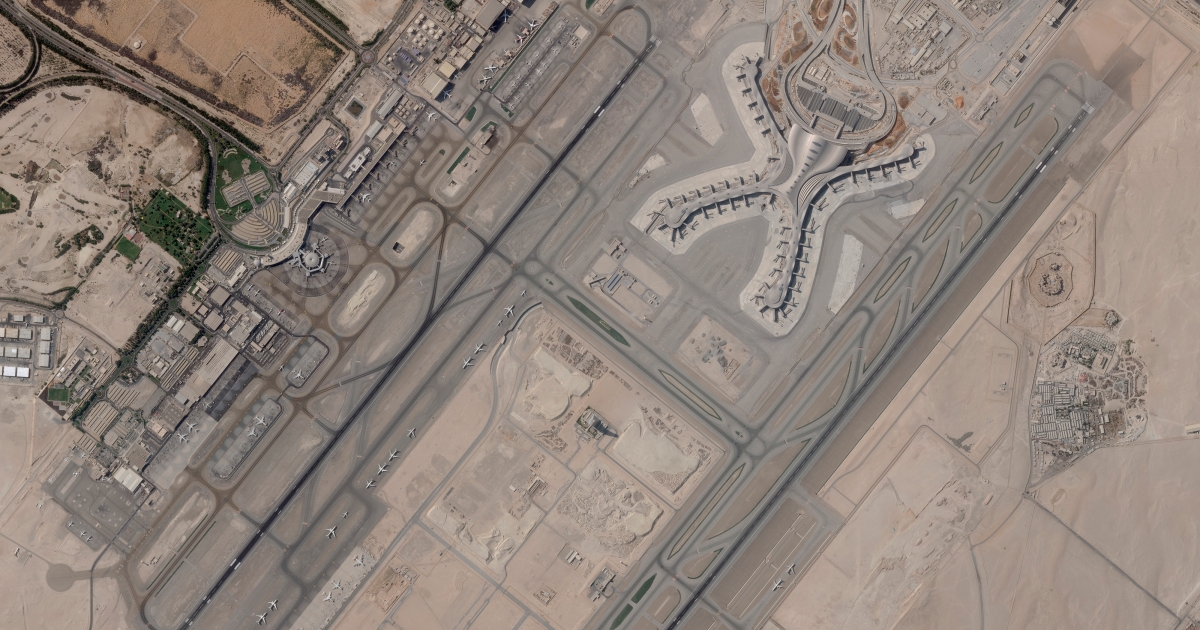
A suspected drone attack by Yemen’s Houthi rebels targeting a key oil facility in Abu Dhabi killed three people and started a separate fire at Abu Dhabi’s international airport, police said.

Police in the United Arab Emirates identified the dead as two Indian nationals and one Pakistani.

“Small flying objects” were found as three petrol tanks exploded in an industrial area and a fire was ignited at the airport, police said, as Houthi rebels announced “military operations” in the UAE.

The UAE which had largely scaled down its military presence in Yemen in 2019, continues to hold sway through the Yemeni forces it armed and trained.

Drone attacks are a hallmark of the Houthis’ assaults on Saudi Arabia, the UAE ally that is leading the coalition fighting for Yemen’s government in the grinding civil war.

Yemen’s conflict has been a catastrophe for millions of its citizens who have fled their homes, with many on the brink of famine, in what the UN calls the world’s worst humanitarian crisis.

Here are the latest updates:


Bahrain ‘strongly condemns’ Houthi attack

Bahrain condemned what it described as a “cowardly terrorist attack”.

In a statement carried by Bahrain’s official state news agency, the foreign affairs ministry said the kingdom “denounces this Houthi attack”.

The Kingdom stands “in solidarity with the United Arab Emirates and all the measures it will take to confront such cowardly attacks,” BNA reported.


UAE condemns ‘heinous Houthi attack’

The UAE condemned a “heinous” attack it blamed on the Houthi rebels.

“UAE authorities… are dealing… with the heinous Houthi attack on some civilian installations in Abu Dhabi,” tweeted presidential advisor Anwar Gargash, referring to the Yemeni rebels.


Houthis ‘capable of carrying out this type of attack’: Analyst

Principal MENA analyst at risk intelligence company Verisk Maplecroft, Torbjorn Soltvedt, said the Houthis have shown in the past that they are “very much capable of carrying out this type of attack”.

The range of the attack “fit with previous similar attacks in Saudi Arabia”, Soltvedt told Al Jazeera.

In previous incidents, they [UAE] have been very measured in their response to such attacks, he said. A big part of that is the “very tense security environment that we have in the region”.

“One of the big questions is … whether or not there’s been any type of direct or indirect Iranian involvement in this attack,” Soltvedt added.


Etihad Airways says flights were briefly disrupted

An Etihad Airways spokesperson said a small number of flights were briefly disrupted at Abu Dhabi airport due to “precautionary measures”, but normal operations quickly resumed.


ADNOC says working with authorities to ‘determine exact cause’ of attack

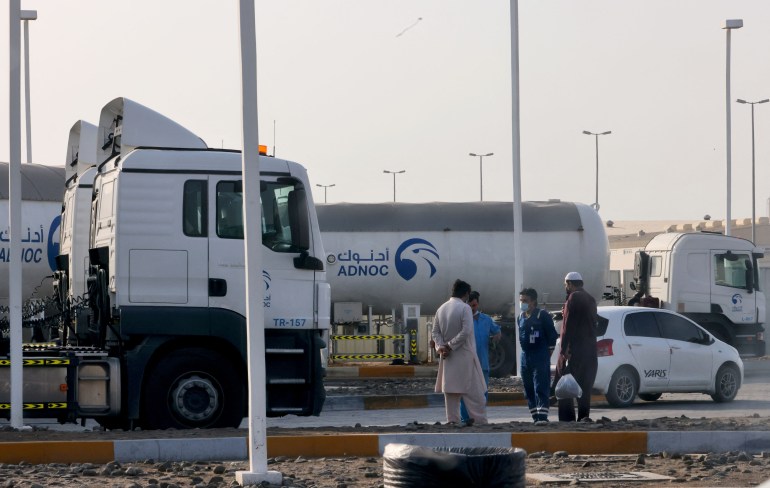
ADNOC oil firm said an incident at its Mussafah Fuel Depot at 10:00am local time had resulted in a fire and that it was working with authorities to “determine the exact cause”.

“ADNOC is deeply saddened to confirm that three colleagues have died. A further six colleagues were injured and received immediate specialist medical care,” it said in a statement.

Police closed the road leading to the area.

“Initial investigations found parts of a small plane that could possibly be a drone at both sites that could have caused the explosion and the fire,” Abu Dhabi police said.


Statement on ‘special military operation’ in UAE coming soon: Houthis

Yahya Saree, the Houthi military spokesman, said in a Twitter post that an “important statement” is coming to “announce a special military operation in the depth of UAE”.


Houthis ‘frustrated’ over Saudi-UAE influence in Yemen: Al Jazeera correspondent

Al Jazeera’s Hashem Ahelbarra, who has reported extensively on Yemen, said that the attack comes against the backdrop of a “massive military operation which is underway now in Yemen”.

“The Saudi-led coalition said yesterday that it has been intensifying their attacks in different areas around Marib, and also major Houthi strongholds,” Ahelbarra said.

Meanwhile, the Houthis have been “frustrated” over what they say is growing Saudi-Emirati influence in Yemen, he said.

The attack on the UAE was carried out as a “show of defiance to the Saudis and the Emiratis,” Ahelbarra added.

“The Houthis are saying despite more than seven years of massive campaigns against us, we are more powerful than before … we have managed to further upgrade our military capabilities to the point that we can launch daring attacks inside Saudi Arabia and the UAE.”

Oil giant ADNOC facility in the capital of the United Arab Emirates, Abu DhabiMen stand outside a storage facility of oil giant ADNOC in…
[ad_2]

Source link

Kazakhstan president orders creation of special forces in wake of mass protests - News

Kazakhstan president orders creation of special forces in wake of mass protests – News

[ad_1]

Law enforcement agencies have also been ordered to establish the exact number of civilian casualties caused by the unrest


By ANI

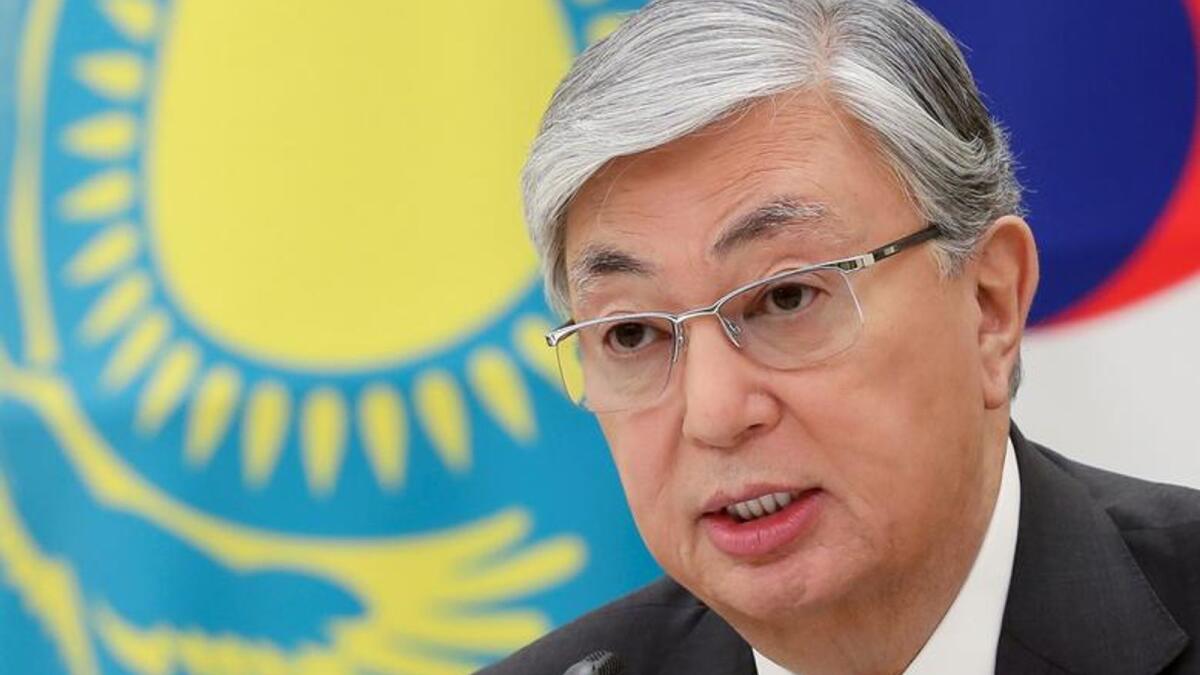
After weeks of protests and unrest in the country, Kazakh President Kassym-Jomart Tokayev instructed the country’s National Security Council to accelerate efforts to establish a Special Operations Force, reported Sputnik.

“Kassym-Jomart Tokayev instructed the Secretary of the Security Council to speed up work on the creation of special operations forces and submit specific proposals for reforming the national security system,” Sputnik reported citing the presidential press service as said in a statement on Saturday.

The law enforcement agencies have also been ordered by the President to undertake an investigation and establish the exact number of civilian casualties caused by the unrest.

ALSO READ:

[ad_2]

Source link

Joshua Johnson Joins Talent War Group as Partner and Co-Director of Leadership Development

Joshua Johnson Joins Talent War Group as Partner and Co-Director of Leadership Development

[ad_1]

AUSTIN, Texas, Jan. 13, 2022 /PRNewswire/ — Talent War Group (TWG) announces that Joshua Johnson, United States Army veteran and retired Special Forces Green Beret, is joining the leadership team as Partner and Co-director of Leadership Development.

With a distinguished 31(+) year military career, Johnson led a team of more than 600 soldiers in various roles, including Group Master Trainer, Special Forces Company Sergeant Major and Battalion Operations Sergeant Major for the U.S. Army 2nd Battalion, 1st Special Forces Group (Airborne), where he managed 21 Special Forces Teams, and two supporting organizations.

During his time in the military, Johnson reported to COL Christopher Jones, who admired his distinctive and meticulous leadership approach, “Josh is a proven, respected leader that attacks the most difficult and complex problem sets with strategic foresight and a deft touch. His leadership, intellect, humor, ability to communicate purpose, and investment in building people and relationships make a difference every day.”

Following Johnson’s military service, he capitalized on his expertise in organizational leadership development and training by creating and delivering managerial and leadership training programs for corporate America. Recently, he worked alongside the West Shore Home team as their Director of Training and Development, training employees from the onboarding process through their development as they were promoted. His wide range of leadership experience enables him to serve as an impact partner to help organizations build their human capital capabilities and execute strategies for long-term success.

Josh Johnson is a rare individual who is committed to excellence and achieving a lasting impact on the development of tomorrow’s business leaders,” said Mike Sarraille, Founder and CEO, Talent War Group. Mike and Josh will work side-by-side to deliver TWG’s mission and create their clients’ legacies of leaders creating leaders. “Josh understands firsthand the character traits needed for today’s dynamic business environment and how to help business leaders implement leadership development systems to grow their talent.”

Johnson joined Talent War Group because of their unique and distinctive approach to leadership development, “I am humbled to have earned the trust of my partners and colleagues, I have no doubt this is the right environment for me to grow and showcase the leadership techniques I acquired in the military. I look forward to working with TWG to deepen our impact for all of our clients.” Josh Johnson, Partner.

Johnson will work alongside Sarraille to refine the company’s growing leadership development services including their experiential development programs, Battlefield Reviews, and soon-to-be-launched, Into the Wild Extreme® (ITW-X).

About Talent War Group
Talent War Group’s depth of industry experience in leadership development, Human Resources, and business operations help deliver sustainable and unmatched talent solutions for their clients. With the ‘train-the-trainer’ model, Talent War Group ensures every organization has the tools to continue attracting, hiring, developing, and retaining top talent long after their engagement. For more information on ITW-X or other leadership development programs, visit talentwargroup.com. ITW-X Video can be found here.

Media Inquiries: Tamara Colbert, PR, c – 626.244.5571; e – [email protected]

Leadership Training Inquiries: Michelle Ballesteros, Talent War Group, t: 512.781.0137, e: [email protected]

SOURCE Talent War Group LLC

[ad_2]

Source link

Ugandan author charged with 'disturbing' president's peace :: WRAL.com

Ugandan author charged with ‘disturbing’ president’s peace :: WRAL.com

[ad_1]

— Ugandan authorities on Tuesday brought criminal charges against an author critical of the government whose ongoing detention has sparked concern at home and abroad.

Kakwenza Rukirabashaija, who has been detained since Dec. 28, was charged with two counts of “offensive communication” for his alleged efforts on Twitter to “disturb the peace” of President Yoweri Museveni and his son, Lt. Gen. Muhoozi Kainerugaba, who commands the East African country’s infantry forces.

Rukirabashaija has since been taken to a maximum-security prison outside the capital, Kampala, according to police. But Rukirabashaija’s lawyer, Eron Kiiza, told The Associated Press that his client had been “secretly remanded” after being charged without notice to defense attorneys.

Rukirabashaija’s next appearance in court has been scheduled for Jan. 21.

“It’s unfair and irregular,” Kiiza said, adding that those who saw his client in the courtroom described him as frail. “He’s a sick man.”

Rukirabashaija’s case has renewed focus on the alleged excesses of the security forces in enforcing Museveni’s authority.

Ugandan authorities were under pressure to free Rukirabashaija or produce him in court after two judicial orders, including one by a high court judge, for security officials to present the suspect in public.

Activists, opposition figures and others in Uganda and outside had called for Rukirabashaija’s release amid reports he was tortured while in custody.

The U.S. Embassy in Uganda had called for Rukirabashaija’s release, saying civil society, human rights defenders, journalists and others “all play critical roles in a democratic society & should be able to carry out their work free of harassment.”

Rukirabashaija, who writes satirical fiction, has been detained twice before over his work highlighting the failures of Museveni, Uganda’s leader since 1986. The writer’s latest trouble stemmed from a series of tweets in which he described Museveni as an election thief and first son Kainerugaba as an overweight and “intellectually bankrupt” soldier who hopes to succeed his father as president.

Kiiza, the defense attorney, said he believed his client had previously been in the hands of the Special Forces Command, an army unit that protects the first family. The Special Forces Command has not commented on allegations it held the writer.

Rukirabashaija, 33, last year was awarded the PEN Pinter Prize for an international writer of courage.

English PEN, a human rights organization for writers, said in a statement last week that it was “gravely concerned” about the author’s detention.

[ad_2]

Source link